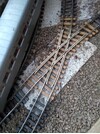
Track making/making tracks: the good, the bad and the ugly, advice and thoughts wanted, explanation is giving(incl mistakes)

With the glue that holds the aluminium rail into the azobe ties/sleepers.
Only get the white high teck from polymax.
There other colours are shrinking to much or will get brittle within a year.
The ties/sleepers with those putties are letting lose, except the ones that were done with white putty.
With 20+ putties tried the polymax high tec beats them all, sticking out with head and shoulders, no doubt!
 
This is thread is going on for almost 3-4 years, incl construction of my house (i am a own contractor so i do all myself).
The end/exame is near!

I bought a loco to play with, some more will follow, to test my tracks.
To build prototypical scale, nearly impossible regarding locos.
Cars and wagons can be done, tracks also.

For whatever reason i build a lot of different scales, all close to and from proto to 1at32 or g scale.
Turnouts, scissor crossovers, crossovers even a 5 way switch ect.
Bottem ;ine if you read the whole thread, they all look good and to my suprise they work also?!?!?!?!?
Yes they work, sort or less

Between the track i keep 45mm.
The catch for good running with loco:
Keep gaps of 2.5mm to 3mm

Wooden ties with soft wood: after THREE years of time in my climat left somewhere in a corner to rot, take a look at the pictures!
With hard wood i did also the same, left in a corner to rot, grass was growing over it, how orse can you make it for wood?
For glue i tried several brands and types of putty/glue, one is sticking out very firm: polymax hi tack (WHITE ONE!!!!!!!!!)
tHE REST NO.

Back to some testing:
On some other treads in this million-dollar forum, i posted some more stupid questions, it all sums up here.
For what i want....yes.

To my suprise some "emplacements" did work, some worked for 80% (attached photo's) and some where a complete disaster.

I learned a lot, i made mistakes and share them in the hope it will benefit you, i also willing to share my succes, patience please, nothing is conclusive ...yet.

Frogs must not be flange bearing and have a gap of 2.5mm just like the safty rail.
45mm between rails and 39mm of total clearance between check/safty rails, frog.
40mm or even 41mm clearance can be done, meaning a gap of 2.5 or 2mm.
2.5 to 3mm gap is i think the way to go(for me it is a 3mm gap)

Below 2mm is just to tight and will give running problems (also i am active on a rail alone build forum)
My triple 3 way switch:
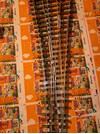
20240715_182622.jpg
It run nice but not at "high"speed it was meant to run at 60km an hour on scale.....15kmh was good.
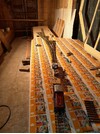
20240715_182603.jpg
It run on almost all directions back and forward.

20240715_183348.jpg
I put some "fillers" to hold the points open for good guidance20240715_183330.jpgHmmmm yeah, derailment, to tight.

20240715_182657_008.jpg20240715_183320.jpg

For prototypical estheticus as you can see, this must be done better.


20240715_193747.jpg
I have a thread somewhere on this million-dollar forum that is dedicated to experiment with moving the points/blades.
The succes was with some really cheap aliexpress tt robot engines and a stupid switch.
Battery on it with a bipolar switch to throw the points.

My luck:
I ran into a project at work to renew a industrial kettle house....switches and boxes enough.(big smile)
I am going to solder some connectors and cable, but that is a future project, i am plowing on in the time that i have...


.


So i can take the electronics inside when i not using them, or all is set right, or move to the other emplacements.
I am planning to make 2 or three switch boxes that can be "universal" use around my track.
Slowly i am getting there and can pull a long nose to that expensive industry...

Next testing subject my 5way switch, my siccor crossover was to tight all over----->disaster.

Thanks for reading and answering with all your tips and tricks to all my stupid questions and ideas, i will certainly keep you posted/updated.
Final (sum up) on how to do it yourself will come also...after all is working, believe me you can do it aswel.

With best regards Igor

 
Last edited:
This summer i will post "how to makes" (maybe youtube? i can not use a pigeon anymore or a telegram?!?!?)with several methods as i did in this topic, so expect one turnout made with 3 different methods...with cheap tools....it so simple....
So the "exam" for several methods...to suit your needs and ability.
Then i will continue with my own garden railway...(its about time....)

Thanks for all the support and help and information sharing!!!
With best regards Igor
 
I'm using one of these for my indoor section
Coupled with this
 
 
After some major life events, I’m finally will able to move forward again in 2026.
Merry Christmas too you all , and here’s to a much better year in 2026 for all of us.

Ohhh, you’ll be absolutely flabbergasted!

You’ll see how simple, cheap, and realistic it can be.
It’s cold outside right now, sorry, I’m Dutch…
But in the meantime(life events) I’ve done a lot of experiments and simplified many things.
You’ll see soon, I’ll post everything.
A lot of problems are solved, and anyone can build this.
It’s incredibly cheap and still looks very good and is prototypically correct!

I’ve adjusted the geometry: the gap between the running rail and the check/guard rail has been increased from 0.75 mm to 2.5 mm.
My KM locomotives run fine even with the 0.75 mm gap, but the LGB/Marklin ones clearly don’t like it.
Any ideas or insights on why this difference occurs?

One more thing: the frog, and the gap between the safety rail and the main rail? in mm? your input is wanted!
Measurements… I’m referring to the spacing between the different rails, including the frog.
Before i am going to post wrong things, many thanks in advance.

With very best regards Igor
 
My KM locomotives run fine even with the 0.75 mm gap, but the LGB/Marklin ones clearly don’t like it.
Any ideas or insights on why this difference occurs?
maybe size and thickness of the flanges?
the taller the flanges in relation to the wheel, the more they point away from the rail in curves.
just guessing.
 
After some major life events, I’m finally will able to move forward again in 2026.
Merry Christmas too you all , and here’s to a much better year in 2026 for all of us.

Ohhh, you’ll be absolutely flabbergasted!

You’ll see how simple, cheap, and realistic it can be.
It’s cold outside right now, sorry, I’m Dutch…
But in the meantime(life events) I’ve done a lot of experiments and simplified many things.
You’ll see soon, I’ll post everything.
A lot of problems are solved, and anyone can build this.
It’s incredibly cheap and still looks very good and is prototypically correct!

I’ve adjusted the geometry: the gap between the running rail and the check/guard rail has been increased from 0.75 mm to 2.5 mm.
My KM locomotives run fine even with the 0.75 mm gap, but the LGB/Marklin ones clearly don’t like it.
Any ideas or insights on why this difference occurs?

One more thing: the frog, and the gap between the safety rail and the main rail? in mm? your input is wanted!
Measurements… I’m referring to the spacing between the different rails, including the frog.
Before i am going to post wrong things, many thanks in advance.

With very best regards Igor
If you can get your hands in a Peco G45 point. The gaps and tolerances work well for G1 finer scale and the newer LGB etc. wheels.
 
I’ve adjusted the geometry: the gap between the running rail and the check/guard rail has been increased from 0.75 mm to 2.5 mm.
My KM locomotives run fine even with the 0.75 mm gap, but the LGB/Marklin ones clearly don’t like it.
Any ideas or insights on why this difference occurs?
I was forced to make a diamond crossing for my railway due to it's location on a curve. (Or even 2 curves).

I tested it with just the running rails fitted and it all ran perfectly.

Buoyed by my success of a working crossing I decided that the crossing looked too bare without the check rails.

The check rails were added and although the crossing looked much better it was the beginning of problems. The tight gaps can be seen here.-

IMG_20200407_191350723.jpg

The first problem was with short-circuits because the backs of the wheels were touching rails of opposing polarity.
The second problem was clearance between the check rails and the running rails..

When I had fitted the check rails, I had given little thought about the clearance beyond testing with a single axle. I should have used a complete bogie
for testing and that is what I used for rectification.
I used a grinding disc in a Dremel to widen the gaps until the bogie ran smoothly over the diamond.
After re-installing the diamond, some loco's and rolling stock still ran roughly over the crossing and therefore the Dremel was used to widen the gaps further.

In the end and I've just measured them, the gaps to the check rails are around the 3.0 mm mark. An adjacent LGB R5 point has gaps of 4.0 mm.

Photo of the "adjusted" junction showing the thinned down check-rails especially in the middle of the diamond but also at the top right. The check rails are a lot thinner than the running rails -
IMG_20251226_112209929.jpg

So 3 mm is a minimum deduced not by theory but by trial and error. You have to accommodate the thickness of the LGB flanges and also the fact that on a 6 wheeled loco the axles are far off the theoretical radial line of the track radius. This was why a single axle would roll fine on the original test but bogies and 6 wheeled locomotives would not run smoothly because of the errors of the radial positions.
If I were to make another piece of track-work I would ensure to have the check-rails at 3 mm.

Incidentally as a final refinement the bottom of the rails were filled with Milliput to stop the wheel-sets from noisily dropping over the gaps in the rails. I made a tool to smooth the filler to a precise depth of 3 mm to suit the depth of the wheel flanges.

AL
 
I was forced to make a diamond crossing for my railway due to it's location on a curve. (Or even 2 curves).

I tested it with just the running rails fitted and it all ran perfectly.

Buoyed by my success of a working crossing I decided that the crossing looked too bare without the check rails.

The check rails were added and although the crossing looked much better it was the beginning of problems. The tight gaps can be seen here.-

View attachment 351432

The first problem was with short-circuits because the backs of the wheels were touching rails of opposing polarity.
The second problem was clearance between the check rails and the running rails..

When I had fitted the check rails, I had given little thought about the clearance beyond testing with a single axle. I should have used a complete bogie
for testing and that is what I used for rectification.
I used a grinding disc in a Dremel to widen the gaps until the bogie ran smoothly over the diamond.
After re-installing the diamond, some loco's and rolling stock still ran roughly over the crossing and therefore the Dremel was used to widen the gaps further.

In the end and I've just measured them, the gaps to the check rails are around the 3.0 mm mark. An adjacent LGB R5 point has gaps of 4.0 mm.

Photo of the "adjusted" junction showing the thinned down check-rails especially in the middle of the diamond but also at the top right. The check rails are a lot thinner than the running rails -
View attachment 351440

So 3 mm is a minimum deduced not by theory but by trial and error. You have to accommodate the thickness of the LGB flanges and also the fact that on a 6 wheeled loco the axles are far off the theoretical radial line of the track radius. This was why a single axle would roll fine on the original test but bogies and 6 wheeled locomotives would not run smoothly because of the errors of the radial positions.
If I were to make another piece of track-work I would ensure to have the check-rails at 3 mm.

Incidentally as a final refinement the bottom of the rails were filled with Milliput to stop the wheel-sets from noisily dropping over the gaps in the rails. I made a tool to smooth the filler to a precise depth of 3 mm to suit the depth of the wheel flanges.

AL
As crucial as the 'gap' is, the running capabilities of home made pointwork need to be governed by the wheel standards for the scale involved - for us it's G1MRA.

The reason being that the check rails act on the back of the flanges and, as we all know, whenever someone posts about a running problem the first question we ask is, 'have you checked the back-to-back measurement on the wheelset?'

I was introduced to this (not that I have ever attempted to build a point or crossing - yet) at a very tender age, when in the UK Protofour was introduced as a fine scale track and wheel standard for 4mm:1ft modelling (now simply known as P4). There was a series of very fine ('scuse the pun) articles in one of the model railway magazines (can't remember if it was railway Modeller or Model Railway Constructor) and I read these avidly and learned an awful lot.
 
I'm not sure that LGB have read the G1MRA standards because their flanges are 3 mm deep (G1MRA specifies 2 mm) :D.
I didn't refer to G1MRA standards when I made the diamond crossing. :(.

AL
 
I'm not sure that LGB have read the G1MRA standards because their flanges are 3 mm deep (G1MRA specifies 2 mm) :D.
I didn't refer to G1MRA standards when I made the diamond crossing. :(.

AL
LGB have to work outside of the general standards because of their initial promise (consistently honoured) to make every model capable of using R1 radius.

The consequence is the need to use very deep and overscale flanges, and the rest is history.

By and large, they have tried to keep their geometry in line with standards, the major issue being frog depth which has been covered on the forum on many occasions in the past.
 
On the subject of Milliput, what do you do with the rest of it when you've opened the fresh packets and taken a small bit out??
Ensure:
a) don't contaminate each roll with particles from the other roll.
b) wrap it up tight to keep the air out.

As it is a chemical reaction, then in theory if not mixed, it will last a long while, however as with most things will "go off" eventually, had mine about 5 years since first opened and still good.
 
Back
Top Bottom